
TLTR
- From Cybercrime Analyst to Team Leader: Bogdana Shynkarenko progressed in no time from a recent graduate to leading the day-to-day operations of the Cybercrime team;
- Career progression built through hands-on experience: immersion, skills development, autonomy and continuous training have helped her gradually strengthen her expertise;
- Knowing how to seize opportunities:for both Bogdana and her manager, Alfred Huot de Saint Albin, professional development depends on boldness, curiosity and the ability to take initiative;
- Preparing the next steps of her cybersecurity career: Python, Software development and Artificial intelligence are the core training topics Bogdana chose to hone her skillset.
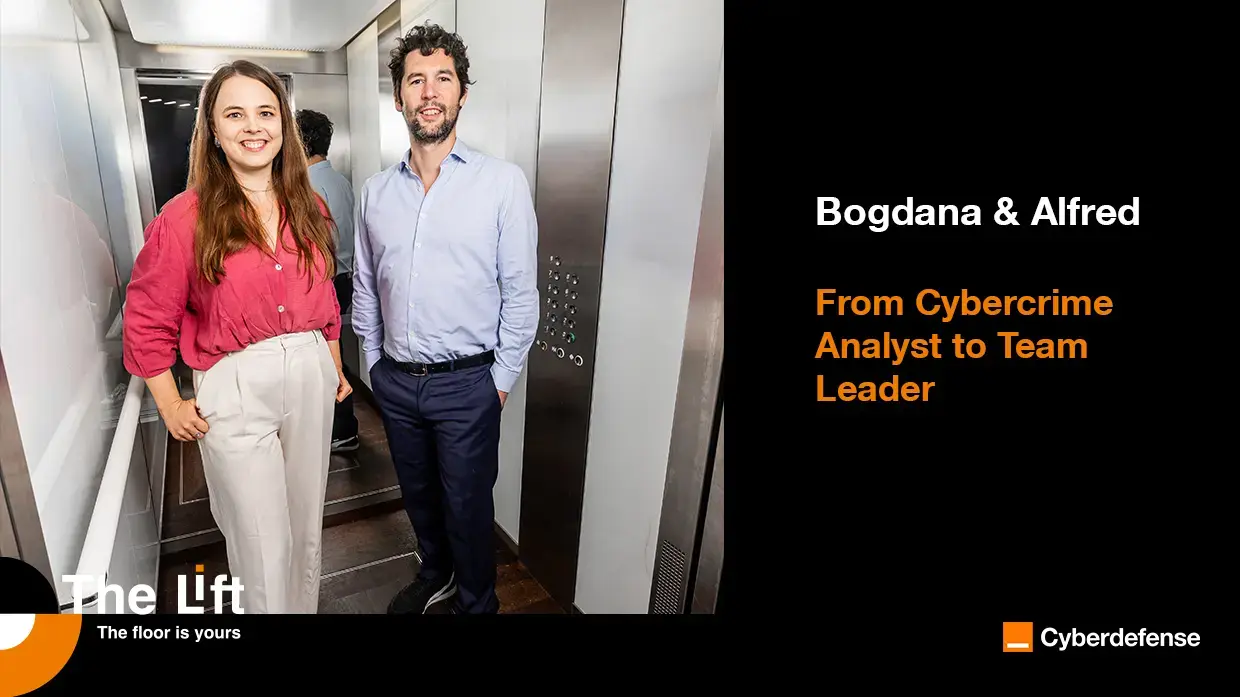
"The Lift": Bogdana Shynkarenko's career progression from Cybercrime Analyst to Team Leader at Orange Cyberdefense
Hired as a Cybercrime Analyst straight after graduating, Bogdana Shynkarenko progressed quickly, becoming a Team Leader within two years. Her career progression was built through hands-on experience, supported by the guidance and trust of her manager, Alfred Huot de Saint Albin. From fraud analysis to coordinating the Orange Cybersecure team, she describes a professional development path where keeping a cool head is essential.
The Lift: The floor is yours
To progress, you need to be bold, but you also need to take the time to train and learn about other roles so you can develop your career. Orange Cyberdefense offers a wide range of possibilities, shares Bogdana Shynkarenko, Cybercrime Team Leader, Orange Cyberdefense.
When did your paths cross? In what context?
Bogdana Shynkarenko, Cybercrime Team Leader at Orange Cyberdefense: "I come from Ukraine, and completed my studies in France after a degree in international law. When I met Alfred, I was studying at the École de Guerre Économique (EGE) and doing a work-study placement in security for Paris airports. I already knew I wanted to move into cybersecurity. Alfred came to present Orange Cyberdefense's activities and different roles, and something clicked. I sent my CV in March. In June, I was contacted about joining Alfred's team, working on threats and fraud."
Alfred Huot de Saint Albin, Head of the Anti-Fraud Unit at Orange Cyberdefense: "I also studied at the École de Guerre Économique and, as Secretary General of the alumni association, I regularly present our activities to new students. That is where I first met Bogdana. It was the beginning of the war in Ukraine, and this dramatic context resonated with me. Yet her skillset and potental was a perfect match for what we wre looking for in our growing team."
When you joined Orange Cyberdefense, what was your skillset, and what did you learn?
Bogdana Shynkarenko: "I learned almost everything here! Through my studies and different internships, I had a grounding in cybersecurity, but this is a profession you learn by doing, in a very stimulating environment. Within four months, I was fully autonomous."
Alfred Huot de Saint Albin: "There is no better way to learn this profession than by practising it. When I recruit, knowledge of the job itself is not the main criterion. What matters most is analytical ability and the ability to integrate into the team and support others. Those two things are essential. The rest can be learned, but it needs structure: we have a development path that gives everyone a common foundation. New colleagues start by identifying types of fraud affecting Orange Cyberdefense's freemium services - for example, URLs submitted by internet users who want to know whether they are fraudulent. They then progress to paid client services of increasing complexity. The whole team contributes to onboarding new recruits. Bogdana followed that path and learned very quickly."
What learning and development opportunities have helped you hone your skills at Orange Cyberdefense?
Bogdana Shynkarenko:"When I joined Orange Cyberdefense as a Cybercrime Analyst, I had just finished my studies, with some experience from internships as a security officer, analyst and quality-control engineer. I was immersed in the work immediately, with very short response times for clients facing attempted fraud. My first challenge was adapting quickly, working to tight deadlines and managing stress. Four years later, I moved into a Cybercrime Team Leader role within the Orange Cybersecure unit. I now have more responsibility and act as the point of contact between analysts, technical teams and communications teams. I am continuing to build my skills. I took Python training a few years back. Many analysts specialise, so I also need to strengthen my areas of expertise."
Alfred Alfred Huot de Saint Albin:"Cybercrime is a demanding service. You need to manage your stress when clients are dealing with crises and accept that you may sometimes have to work weekends. I am transparent about that during recruitment interviews. But people receive a great deal of support when they join and as they develop their skills. Our analysts begin with small, everyday assignments, then move on to specific and sometimes difficult cases so we can see how they handle them, how they approach a problem and whether they can persevere when things become complex. There is no single major challenge - it is more about overcoming small challenges every day. That is a very effective way to progress."
What role has Alfred played in your professional development?
Bogdana Shynkarenko:"First of all, he recruited me! From the beginning, I felt supported as I gradually became more autonomous. Alfred helped me progress and, above all, trusted me. That matters when you are coming straight out of education."
Alfred Huot de Saint Albin: "As Team Leader, Bogdana manages day-to-day operations and schedules, quality control and the writing of expert articles for the community. I know that when I am away, she will make the right decisions. Of course, when I need to step in as her manager, I play that role. But Bogdana runs the activity day to day. We receive very few reports of classification errors, the analysts work well and quality control is effective. Four years after she joined, it is a strong example of career progression and a real success."
How do you breathe Orange Cyberdefense's Hacking spirit?
Through my studies and internships, I learned the basics in cybersecurity, but its a field you can really own by doing it. Within four months, I was 100 percent autonomous, recalls Bogdana.
What hard skills and soft skills immediately standed out with Bogdana?
Alfred Huot de Saint Albin:"I quickly realised that Bogdana was discreet and had a strong understanding of confidentiality. That's important because we work with sensitive data. For example, she would never discuss those subjects loudly with everyone in the open-plan office. That discretion is essential. She is also very well organised, and her progression into the Team Leader role happened naturally."
What is your shared view of career progression opportunities at Orange Cyberdefense?
Alfred Huot de Saint Albin:"Professional development starts with the individual. People who want to progress need to know how to seize opportunities. Bogdana did that with the Team Leader role. Some people use their own time to train themselves and develop. For example, one analyst in the team moved into development, while another moved into penetration testing after spending weekends learning about it. Cybercrime is not usually a destination for an entire career; it is an entry point because it is one of the less technical roles in a highly technical environment. Further progression requires specialisation."
Bogdana Shynkarenko:"Exactly. You need to be bold, but you also need to take the time to train and learn about other roles so you can develop your career. Orange Cyberdefense offers a wide range of possibilities and professional opportunities! If I could send a message to myself on the day I was recruited, I would tell myself to be more confident and not be afraid to take initiative."
And how do you see our company culture, the famous "Hacking spirit"? How do you experience it day to day?
Bogdana Shynkarenko: "The "Hacking spirit" means being highly curious and tenacious: you need to understand and analyse, but also refuse to give up until you reach your goal, especially when fraudsters are becoming increasingly inventive."
Alfred Huot de Saint Albin: "I agree with Bogdana. It is essential to dig into a case and understand how a fraudster operates in order to achieve their objective. That takes time. I try to give everyone enough time to analyse, investigate, do development work and help one another. The "Hacking spirit" also means being highly responsive. We operate like an emergency service: you need to move very quickly while maintaining a high level of quality and following the right processes."
Do you have an anecdote to share, a piece of advice that stayed with you, or something you’ve never dared to say before?
Alfred Huot de Saint Albin: "When I joined, there was only one woman in the team. Today, we are 50/50 - genuine gender parity across the Cybercrime teams in Paris, Montreal and Singapore. That is notable because women account for around 20% of the cybersecurity sector. When I recruit, I focus on the quality and diversity of profiles rather than gender, so that we have complementary perspectives."
Bogdana Shynkarenko:"That is absolutely true. The teams include people with technical backgrounds, but also geopolitical expertise and foreign-language skills. That diversity of expertise is a major strength."
Artificial intelligence is developing fast: is it already affecting your roles?
Alfred Huot de Saint Albin: "Everyone is talking about artificial intelligence, but there are still relatively few genuine experts. For fraudsters, AI is a powerful accelerator that helps automate their operations. Of course, we need to adapt. Internally, we use the Dinootoo AI platform every day. The challenge is learning how to use this new tool intelligently. That means recruiting people who know how to follow the right procedure while also thinking outside the box. We need to keep developing our skills so we can master AI."
Bogdana Shynkarenko: "I use AI for coding and automation. It is an innovative tool that will help us deal with an ever-growing volume of threats. We use it to reduce our workload. At the same time, the fraud team has doubled in size, particularly to support the scale of the Orange Cybersecure project. So AI is not a threat to jobs."
Explore the other floors of "The Lift" series below.


