
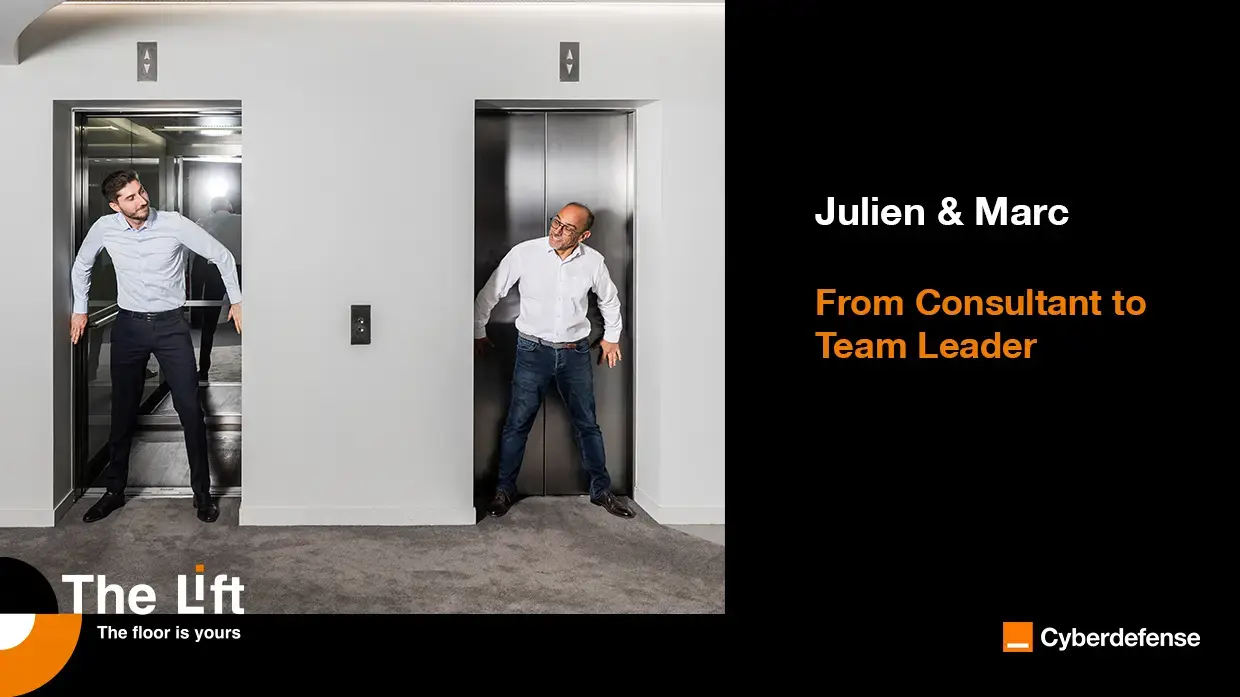
The Lift, episode 8: from Cybersecurity and Crisis Management Consultant to Team Leader with Julien Champion
TLTR
- In seven years time, Julien Champion progressed quickly. After joining as an intern, he was hired as a Junior Consultant, then became a Consultant and Senior Consultant, and has now been a Team Leader for six months;
- Networks, penetration testing, crisis management, governance...Across his assignments, Julien has developed his technical skills as well as soft skills such as public speaking;
- His approach to career progression? Earning certifications and leading major international projects, while showing boldness and autonomy;
- Julien says it, and his experience demonstrates it: for those who know how to seize them, there are many career opportunities at Orange Cyberdefense to explore technical expertise, consulting and management, and to build a career path around their ambitions.
"The Lift”: from Cybersecurity Junior Consultant to Team Leader at Orange Cyberdefense France
In seven years, Julien Champion has built his career at Orange Cyberdefense France by gaining experience across a wide range of assignments and certifications after first joining as an intern. Starting as a Junior Cybersecurity Consultant, he quickly progressed to Senior Consultant before becoming a Team Leader and taking responsibility for his own team. He has developed his expertise across areas ranging from crisis management to international projects, while also working on interpersonal skills such as public speaking. His career path has been supported from the outset by his manager, Marc Tolub, who recognised his potential early on.
The Lift: The floor is yours
At Orange Cyberdefense, continuously developing soft and hard skills is a driver of growth, tells Julien Champion, Team Leader, Orange Cyberdefense France.
When did your paths cross? In what context?
Julien Champion, Team Leader at Orange Cyberdefense France: “For my final engineering-school project, I applied for an internship at Orange Cyberdefense France. I had interviewed with several other companies, but my interview with Marc convinced me immediately: he did not oversell the company or the role. He was very genuine, explaining what my role would involve and what progression opportunities I could have. That honesty won my trust.”
Marc Tolub, Senior Manager, Consulting and Audit at Orange Cyberdefense France: “I agree with Julien about the importance of trust. When I recruited him seven years ago, I was building my consulting and audit team and we needed an intern to work on crisis management. At the time, that expertise barely existed. I wanted to develop an offering for public- and private-sector organisations to help them respond to and manage cyberattacks. Of course, I was looking for technical expertise, but also for someone who could handle stressful situations. That is exactly Julien’s profile.”
When you joined Orange Cyberdefense, what what your skillset, and what did you learn?
Julien Champion: “When I stepped in, I already had expertise in networks, technical penetration-testing skills and a specialisation in project management. I wanted to develop skills in organisational security and cybersecurity governance. Above all, I was aware of my weaknesses: when I finished my studies, I was shy and nervous about speaking to people or even sending them a message. I knew I needed to work on that. So I put a lot of effort into social interaction and client relationships. From my first assignments with other colleagues, I saw what a team of professionals really looks like. I had to change my mindset, moving from a student who was still learning to an expert who understood the topics regarding our clients needs. Coming from a very engineering-focused background, I was surprised by the variety of career paths in the team: some colleagues came from Political affairs, others from Crisis management or Law school. That multidisciplinary mix is a real strength.”
Marc Tolub:“I deliberately want my teams to include people from different backgrounds. We work with companies facing a wide variety of issues, so we may be speaking to a CISO, CEO, HR Director or CFO. We take a holistic approach to client issues because a cyber crisis affects the whole organisation. Today, Julien came from engineering school but can discuss topics related to communications or human resources. His expertise has developed through working with the team and the different issues he has encountered.”
Can you give an example of a success or a challenge you overcame?
Julien Champion:“Without hesitation, I would say an international client in the luxury sector. We sold a cyber crisis management exercise programme designed to simulate an attack and train teams. We worked with ten entities around the world, so we had to take different cultures into account, meet the local teams and understand each specific context. One important detail was that we came in after a provider whose work the previous year had been very poorly received. We could not afford to get it wrong because the entire programme could have been called into question. We proved that they could trust us. Today, those entities contact us directly.”
Marc Tolub: “Julien is being modest: he led the entire project! It reflects his progression in both soft skills and expertise. You can measure that career progression through client satisfaction. When a Consultant is able to represent the company on strategic, ambitious projects for major accounts, it shows a high level of professional maturity.”
How has your career progressed at Orange Cyberdefense?
Julien Champion:“After my internship, I was hired as a Junior Consultant for two years. I then spent the next two years as a Consultant before becoming a Senior Consultant in 2023. In 2026, I became a Team Leader, with management responsibilities. Moving into management was one of my professional development goals. Both of my parents are Managers, so I had an idea of what the role involved and it interested me. When the opportunity came up, Marc supported my application. Moving into management changed my position: I am no longer simply a colleague. You have to establish your authority, adapt your behaviour, show leadership and put certain guidelines in place. It is my responsibility to be there for my team and make sure everyone feels supported.”
What technical skills or certifications have you gained to hone your senior expertise at Orange Cyberdefense?
Julien Champion: “I have always set myself certification goals every year, not necessarily to learn something new, but to validate expertise I had already gained. That is why I took the ISO 27001 cybersecurity certification. Theory is important, but you learn most in the field. Certifications provide proof. My most recent one is the "CISSP" - Certified Information Systems Security Professional - an internationally recognised certification with a reputation for being difficult. I earned it after five years of experience. In every area, I like to build up specific skills, a bit like levelling up in a video game! For example, to develop my skills, I took soft skills training to improve my public speaking. Today, I can give presentations and speak at conferences while managing my stress, something I would have been unable to do a few years ago.”
What role did Marc play in your professional development?
Julien Champion: “He played a key role! Marc trusted me and has always been there to steer and guide me, while still giving me the autonomy to go through my own experiences and difficulties. He managed to push me beyond what I thought I could do, towards my ambitions, while giving me the tools I needed.”
Marc Tolub: “To add to that, I supported Julien in two ways. The first was the more conventional route: directing him towards training and programmes that could accelerate his progression towards greater expertise or management responsibilities. The second was to put him straight into the deep end. Nothing consolidates professional development and skills like real-world experience. Julien wanted to move into international project management. As soon as an opportunity came up, I encouraged him to take it. Training gives you a foundation, but nothing replaces dealing with real situations. Whether formally during annual reviews or informally over coffee, Julien has always told me about his career ambitions. That allowed me to help him build a trajectory. It is easier to support someone who has a clear idea of the career path they want to build.”
How do you breathe Orange Cyberdefense's Hacking spirit?
You try to break through a barrier and hack the system, says Julien.
What hard skills and soft skills immediately standed out with Julien?
Marc Tolub: “His calmness. Julien has a very composed personality. He knows how to step back and gain perspective so he can reassure clients facing extraordinary, anxiety-inducing situations and significant pressure. Keeping a cool head and reassuring people are important interpersonal qualities when working with clients.”
Julien Champion: “The primary role of a Cybersecurity Consultant is to advise clients on how they can improve. Crisis management is a specific discipline. The real pressure often comes from meeting clients: one day I might be sitting opposite an executive from a major CAC 40 company, and the next I might be working with the head of an SME. Expectations are different. You have to adapt the way you present yourself, answer questions, meet deadlines and still deliver high-quality work. The pressure comes more from the consulting role itself than from the crisis.”
What is your shared vision regarding career development opportunities at Orange Cyberdefense?
Julien Champion:“You need to have a clear idea of your ambitions and what you want. At Orange Cyberdefense, there is flexibility and there are career opportunities for people who want to move into management, technical expertise or consulting. The company may not be able to meet every ambition 100%, but every employee has plenty of options available to them. My advice is to ask yourself what you want to do, think ahead and avoid seeing a career path as a straight line.”
Marc Tolub:“The Orange employer brand is a strength. It gives people considerable room to move and progress. When someone has a good idea, we can connect that idea with the right people and put resources behind it. There is a strong entrepreneurial side to Orange Cyberdefense. In the consulting and audit teams, we do not work in silos. You can join with expertise in one area and explore others across disciplines. Depending on their interests, someone joining us early in their career can specialise in crisis management, Governance, Risk and Compliance, GRC, or other areas.”
And what is your view of our company culture, the famous "Hacking spirit"?
Julien Champion:“Boldness is one of Orange Cyberdefense’s core values, and it is probably the value that resonates most strongly with our company culture. You should not hesitate to try, take risks, experiment, fail... and improve. Penetration testing is a good example: you try to break through a barrier and hack the system. At first it does not work, so you rethink the way you are looking at the problem, talk it through with other people and eventually find a solution that is very different from your first approach.”
Marc Tolub:“That mindset originally comes from finding innovative strategies for getting into an information system. To make progress, you need imagination and strategy. It takes determination, perseverance and proactivity. That's exactly what the "Hacking spirit" is all about.”
Artificial intelligence is rapidly advancing in cybersecurity: is it already impacting your work?
Marc Tolub:“For our consulting roles, it is a evolution. AI is changing the landscape, but that does not mean we should be afraid of it. By automating the least interesting tasks, we can focus on higher-value activities. It is up to us as managers to support younger consultants as they develop and integrate these new ways of working.”
Julien Champion:“Take meeting minutes as an example. Now it takes 15 minutes to review them, whereas writing them used to take two hours. In Consulting, we sell "brain" services. That is very different from highly technical roles such as penetration testing, where AI will explore vulnerabilities and interact with new systems. We use it to save time, provide a starting point for our thinking, identify blind spots and challenge ourselves. It helps us improve the quality of our work.”
Explore the other floors of "The Lift" series below.


