
The Lift, episode 10: from hospitality to Project Manager in Belgium - Rares Madarasan’s career change
TLTR
- A successful career change: coming from Hospitality, Rares Madarasan decided to engage in IT training during the Covid pandemic before joining the Orange Cyberdefense Belgium Service Desk;
- Career progression built step by step: there, Rares worked his way through the different levels before moving into a Project Manager role at the Defense Center. A successful career transition;
- Experiences that accelerate development: from e-bonding projects to helping open the Service Desk in Cairo, Rares demonstrated his ability to train teams and share expertise;
- A career path driven by the desire to learn:training, trust from managers and internal mobility supported his move into project management, with the backing of his manager, Akim Allal.
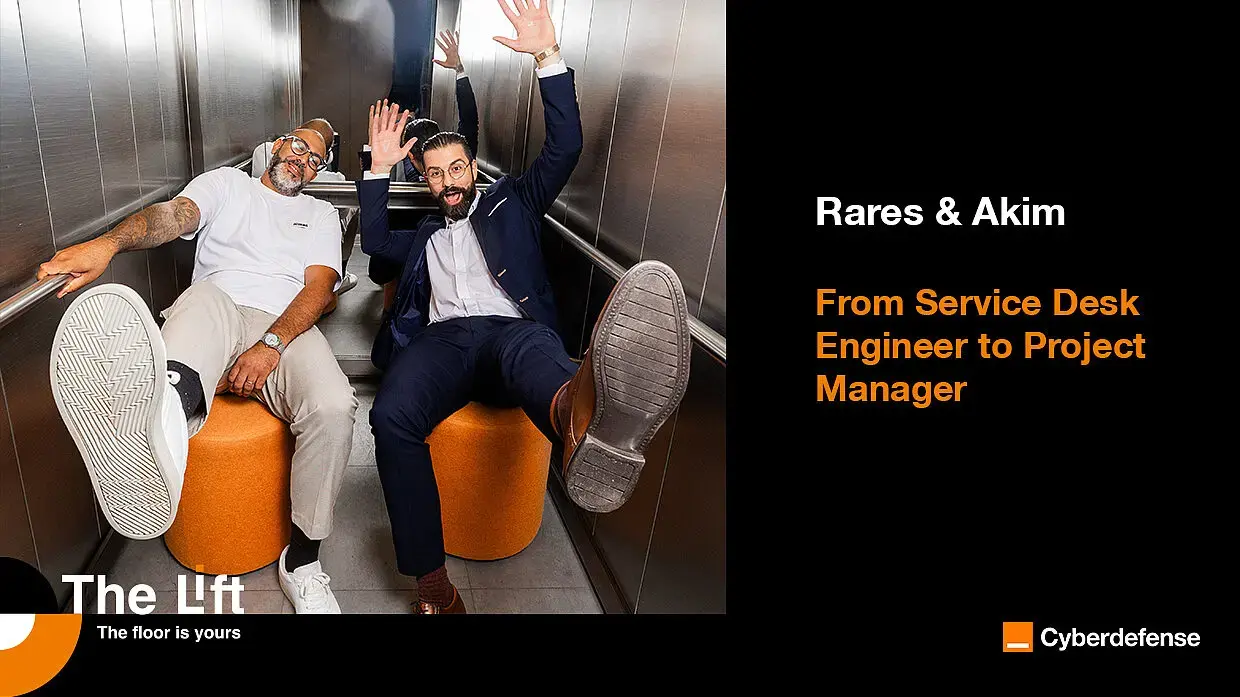
“The Lift”: Rares Madarasan’s successful career change from Hospitality to Project Manager at Orange Cyberdefense Belgium
How do you move from hospitality into cybersecurity, then progress into project management? Rares Madarasan’s career change shows that people with unconventional backgrounds can build a career at Orange Cyberdefense. On the Service Desk, Rares gained experience across a range of projects and developed his expertise by training new team members in Cairo. Now a Project Manager in the Defense Center, he is responsible for onboarding new clients. His successful career transition has been driven in particular by persistence and strong interpersonal skills.
The Lift: The floor is yours
At Orange Cyberdefense, unconventional backgrounds can build a career and lead to a strategic position, comments Rares Madarasan, Project Manager at Orange Cyberdefense Belgium.
When did your paths cross? In what context?
Rares Madarasan, Project Manager at Orange Cyberdefense Belgium: “My cybersecurity career began during the Covid-19 crisis. I had trained in hospitality management and was working casual shifts in the hospitality sector. When the pandemic hit, I was one of the first to lose my job. A friend kept encouraging me to get into IT and take certifications such as the CCNA - Cisco Certified Network Associate. After a month sitting on my sofa doing nothing, I thought: let’s give it a try. After an initial introduction through YouTube, I found a network administrator training course. One of my classmates from that course was hired by Orange Cyberdefense. He told me the company was looking for someone to join the Service Desk, where Akim worked, and we became colleagues.”
Akim Allal, Service Delivery Manager, Orange Cyberdefense Belgium: “We both have unconventional backgrounds! I started working in IT in my twenties, then completely changed direction and became a part-time educator in a primary school. When I started a family, I needed a more stable situation. My best friend worked at Orange Cyberdefense and introduced me. My IT skills were not particularly strong, but I was good with languages: I speak English, French and Dutch. The company happened to need a Dutch speaker. I started on the Service Desk, right at the bottom of the ladder, and stayed there for four years. That is where I met Rares. I saw a highly motivated young man arrive, eager to learn. On the Service Desk, you may speak to more than fifty different clients, which is a huge amount of information to absorb when you are starting out. Making mistakes is normal, and Rares made some at first. But I saw someone determined, who learned quickly and said he wanted to stay in the company and progress. When I became Team Leader, I needed a right-hand person. By then, Rares was one of the most experienced people in the team, so he was the obvious choice.”
When you joined Orange Cyberdefense, what was your skillset, and what did you learn?
Rares Madarasan: “Everything was new! As I said, I came from a completely different professional world. The first three months were difficult. I was discovering a new field, new expectations and new processes. As Akim often says, it takes at least a year on the Service Desk before you can really say you are autonomous. After a few months, I started to feel more comfortable and tried to take on more tasks that would normally be given to senior colleagues. When Akim became Team Leader, it felt obvious that I should support him in turn, just as he had supported me when I first arrived.”
Can you give an example of a success or a challenge you overcame?
Rares Madarasan:“First, there were the e-bonding projects(1), where I worked more independently, although Akim was always there to support me. I was on calls with clients and working with internal stakeholders such as Developers, Project Managers and SDMs - Security Service Delivery Managers. But the project I really enjoyed was Cairo. I went there to help open the Service Desk. For two weeks, I trained ten newly recruited team members. That challenge helped me develop a great deal and marked an important step in my career progression. If I had to do it again, I think I would rehearse the presentations and training sessions beforehand so that I felt more comfortable delivering them.”
Akim Allal: “The Egypt project was a real challenge. We moved the services from Mauritius to Cairo and started again from scratch. The team had no experience of Orange Cyberdefense practices. Most of them held CCNA certifications, but on the Service Desk, technical work represents only about 20% of the role. The rest is process. That experience taught me to trust people. As Team Leader, delivering the training fell within my responsibilities. But I had been away from day-to-day operations for a year, so I preferred to entrust the mission to Rares and my teams, who were closer to the work, and give them the opportunity to demonstrate and share their knowledge. At the same time, my own management trusted me too. Initially, they were not in favour of sending non-managers to Cairo, but they gave me the freedom to do things according to my vision. I really appreciated that.”
What has been your career evolution at Orange Cyberdefense?
Rares Madarasan:“I joined Orange Cyberdefense a little over four years ago. After my initial immersion on the Service Desk, I started training new members of the team. More broadly, I trained second-line engineers and anyone joining us. During those three years, I was never bored. A few months ago, I moved into a division called the Defense Center, where I work as a Project Manager responsible for onboarding new clients. My current manager approached me at a barbecue. I told her I wanted to become a Project Manager, and she opened the role for me. Now I am back at the bottom of the learning curve: I want to become genuinely good at this new profession too. But learning and progressing are part of the process. Ask me again in six months!”
What learning and development opportunities or certifications have you benefited from at Orange Cyberdefense?
Rares Madarasan: “During my annual review, Akim supported my move towards Project Management. He encouraged me to take training courses offered by Orange Cyberdefense. I completed the training last year, and I have now been a Project Manager for six months. So I have progressed internally, first within the Service Desk and now into the Defense Center.”
What role did Akim play in your professional development?
Rares Madarasan:“During my first few months in the role, Akim was always there to help me progress. I never felt I had been left on my own. We have always had an excellent working relationship built on trust, reciprocity and solving problems together, without negative judgement. That mindset gave me the confidence to interact with different departments across Orange Cyberdefense and trust my own abilities more.”
How do you breathe Orange Cyberdefense's Hacking spirit?
At Orange Cyberdefense, as long as the work gets done, your manager is not going to check every task or micromanage you in a counterproductive way. I have the freedom to progress and to work in the way that suits me. That matters, says Rares.
What hard skills and soft skills immediately standed out with Rares?
Akim Allal:“The first thing that struck me was his soft skills. Rares arrived with a fairly technical background, but what I really saw was someone very sociable, comfortable dealing with clients and able to do so in several languages. He is very likeable and everyone appreciates him. Positive personalities have a significant impact on the overall working atmosphere. I quickly saw that he could make an excellent Service Delivery Manager. He is the complete opposite of me, because I am quite reserved! It takes me time to approach people, whereas Rares can start talking comfortably to almost anyone right away. For a client-facing role, that is essential. I am proud to see Rares’s learning curve and to see how happy he is in our company. That is probably what matters most to me. I recognised his potential to become a Project Manager, but above all I am pleased to see that he has found fulfilment in his career path.”
What is your shared vision regarding career development opportunities at Orange Cyberdefense?
Akim: “There are a lot of professional opportunities. Most of the people I have worked with are young, and for many of them it is their first job after graduating. I am 41, and I do not know whether it is generational, but younger people often want to move very quickly. In a company like Orange Cyberdefense, you need some patience. Show what you can do, and at some point an opportunity to move into a more senior role will come. Patience is therefore key. You should not expect a meteoric rise in the year after you join. I also see that, in this company, it is possible to be hired and progress without any previous experience in IT or cybersecurity.”
Rares: “Orange Cyberdefense invests in its people through training and progression opportunities. Neither of us came in with a strong technical background, but we were given time to learn and the resources we needed. In the first year, you discover the profession. Over the next two, you start creating value for the company. And in the following two, you become a real expert!”
And what is your view of our company culture, the famous "Hacking spirit"?
Akim Allal: “The fact that neither of us comes from an IT background shows how open the company is to people from different walks of life. That culture is also reflected in flexible, deeply human management. I have two children. When I was still right at the bottom of the ladder and my daughter was ill, my manager would say: "What are you still doing here?" ”
Rares Madarasan: “At Orange Cyberdefense, as long as the work gets done, your manager is not going to check every task or micromanage you in a counterproductive way. I have the freedom to progress and to work in the way that suits me. That matters. I also think Orange Cyberdefense makes a smart bet by giving opportunities to people who do not tick every box. I was given the chance to prove myself and, in return, the company earned my loyalty. I have gained more balance and a better quality of life. That is valuable. I could earn more money at another company, but that kind of mindset makes all the difference.”
Artificial intelligence is rapidly advancing in cybersecurity: is it already impacting your work?
Akim Allal:“I use AI a lot through Dinootoo(2), the tool developed by the Group. One of my main activities is preparing client presentations. Artificial intelligence saves an enormous amount of time. Something that would have taken me a week to prepare can now be done in five or six hours. Clients are very happy with the results; they can see the difference.”
Rares Madarasan: “Before I left the Service Desk, we launched a new major incident management unit. And I can confirm what Akim just said: using Dinootoo to analyse tickets saved us a huge amount of time. Of course, it is not 100% perfect. We still need to check what is sent to clients and stakeholders. I think we are still experimenting with the tool. It will take time before we reach a mature, advanced use of artificial intelligence.”
Explore the other floors of "The Lift" series below.
Footnotes
(1) eBonding is the automated connection between the service management systems of different organisations;(2) Dinootoo is the secure AI platform developed by Orange for its staff, which is subsequently offered to customers under the name "Live Intelligence". This tool brings together several AI solutions available on the market within a single service, designed to ensure secure use and data privacy.


