

25 September 2026 | Blog
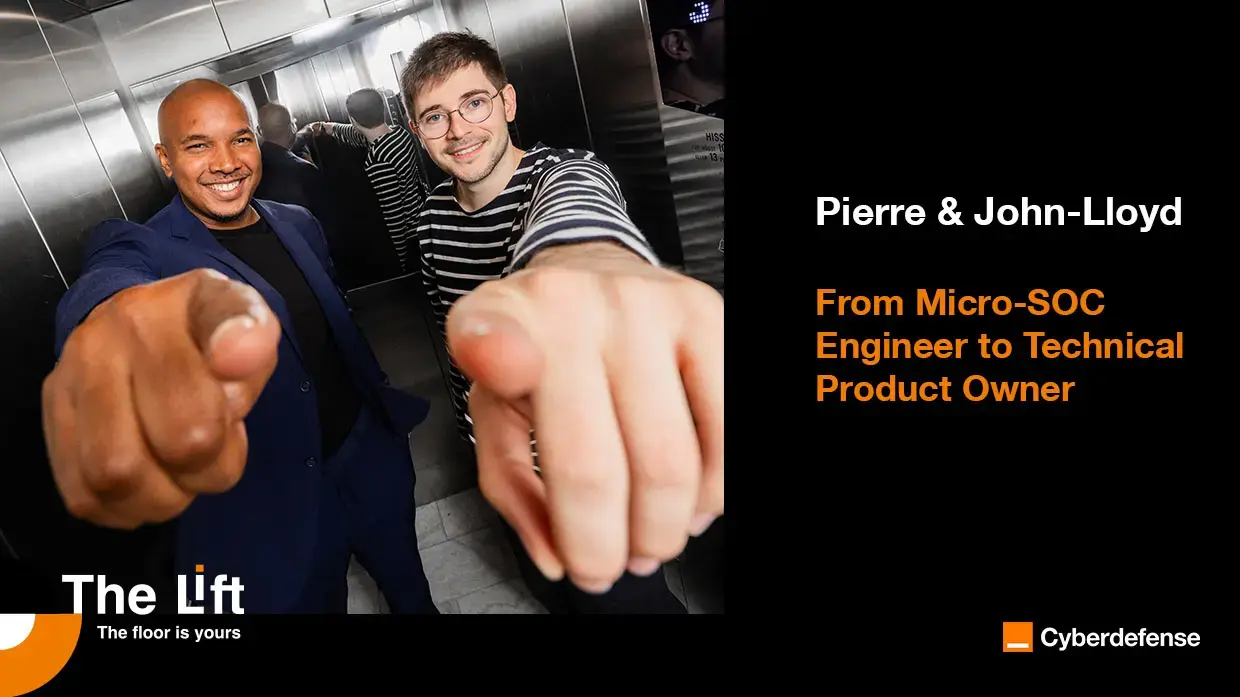
Travel broadens the mind, as the saying goes. In this new episode of "The Lift", discover Pierre Lelièvre’s career path at Orange Cyberdefense Norway and how internal mobility enabled him to progress internationally. From Micro-SOC engineering in Paris to a Technical Product Owner role in Oslo, his professional development is grounded in one mindset: there are no problems, only solutions.
For me, a problem is always a starting point. I enjoy challenges when they are constructive, reflects Pierre Lelièvre, Technical Product Owner, Orange Cyberdefense Norway.
John-Lloyd Hamlet, Vice President MSS Service Design at Orange Cyberdefense Norway: “We first met over a video meeting! I was looking for someone with a high level of technical expertise and a disruptive approach. Pierre’s name was suggested to me, so I called some of his former colleagues and managers. I quickly realised he was exactly what I was looking for, combining creativity with simplicity. Pierre has this ability to challenge everything in a very pragmatic, common-sense way. That is exactly the kind of mindset you need to build your skills and progress your career at Orange Cyberdefense.”
Pierre Lelièvre, Technical Product Owner at Orange Cyberdefense Norway: “I had already seen John-Lloyd in meetings, but he was speaking English. During our first conversation, I was very surprised to hear him speaking French! Of course, we discussed technical topics, but what struck me most was that John-Lloyd genuinely wanted to change things and had the responsibility to make that possible. Promises of transformation do not always translate into action. Here, I felt that change really could happen. That is what convinced me to accept the role.”
John-Lloyd Hamlet:“Pierre had already launched the highly disruptive "Slash" project in France, which I wanted to replicate for Orange Cyberdefense Norway. It involves adding an extra layer to our ticketing system to improve day-to-day productivity and visibility. The topic was not particularly popular because it touched the foundations of Orange Cyberdefense. If we got it wrong, everyone would know about it. But we believed in it, with the support of a manager. We tested several strategies and demonstrated the value of the project. Our approach was simple: ask analysts what was getting in the way of their work and what they wanted to improve. Listening to them motivated the analysts, and they later became the strongest advocates for the change. That way of working changed the mindset of our organisation. We successfully replicated it on other projects.”
Pierre Lelièvre: “French people are very good at challenging things and spotting what is wrong... Yet without necessarily coming up with solutions (laughs). For me, a problem is always a starting point. I enjoy challenges when they are constructive.”
Pierre Lelièvre:“I had just graduated and lacked practical knowledge in a lot of areas. I am naturally quite reserved, so I had to learn how to speak to colleagues and call clients. As a student, I was not even comfortable ordering a meal in a restaurant, and suddenly I had to communicate serious issues, such as suspected attacks, to 25 clients. At university, you learn the theory. Once I started working, I really understood the purpose behind the job: I worked with hospitals, local authorities and agricultural businesses. These activities are essential, and so is their security. It is our responsibility to protect them with commitment and accountability. I had not fully appreciated this concrete reality while I was studying.”
Pierre Lelièvre:“When I started my career at Orange Cyberdefense as a Micro-SOC Engineer, I had just graduated. Based in La Défense in Paris, we were a small team of ten with a start-up mindset and very rapid growth. Three years later, there were 80 of us! During that period, I started as a Cybersecurity Engineer, working on Run and Build (1) operations of course, but also on Research & Development to improve our services. After a year, I progressed to become Product Owner for the Micro-SOC service, with responsibility for optimising the tool I was working on. I then moved into a Technical Product Owner role at Orange Cyberdefense Norway's offices in Oslo. In five years, I have significantly strengthened my career path.”
Pierre Lelièvre: “Yes, I am now based in Oslo. During my engineering studies, I spent time in Bulgaria on Erasmus. I loved being immersed in a new culture and meeting people from very different backgrounds who broadened my perspective. I wanted to gain more international experience and had planned to go to Norway for my final internship. Covid disrupted those plans. Instead, I completed the internship as a Micro-SOC Analyst at Orange Cyberdefense France and was then hired. But I still regretted not going to Oslo, and life in Paris was becoming difficult for me. While looking through vacancies on the Group careers site, I found a Security Analyst role at Orange Cyberdefense Norway. The timing could not have been better! I contacted the HR manager, and the following week I had an interview with John-Lloyd. I landed the position and started four months later!"
Pierre Lelièvre:“I have not necessarily taken formal certifications to develop my skills, but I have worked across very different areas, particularly detection and remediation. Nothing teaches you more than that.”
Pierre Lelièvre: "One unusual aspect of the way we work is that our relationship is remote: I am in Oslo and John-Lloyd is in Stockholm. Distance could be seen as a barrier, but it works.
John-Lloyd: "Pierre does not need micromanagement. He is given a direction, follows it and finds the right people to work with. I have to admit that on multiple occasions Pierre surprised me by his sense of initiative".
Pierre Lelièvre: “He recognised my motivation and gave me the space to develop. In a large company, it is difficult to change everything overnight. John-Lloyd helped me accelerate things, and without him it would probably have taken longer.”
The CTF - "Capture The Flag" - competition organised by Orange Cyberdefense for students is a perfect illustration of the famous "Hacking spirit". I really like this mindset, because you’re judged above all on the approach you take to solving a problem, and not necessarily on the solution itself, says Pierre enthusiastically.
John-Lloyd Hamlet: “I appreciate the way Pierre simplifies problems and quickly finds solutions. He brings his technical expertise to create scripts and solve problems through innovation, which is impressive. Pierre is also very self-directed: we have a lot to do, and autonomy is essential. I quickly realised I could trust him completely and sleep soundly at night.”
Pierre Lelièvre: “On my side, if I were constantly being watched and required to report on everything, it would not work for me!”
John-Lloyd Hamlet: “Even before technical performance, curiosity comes first. As a manager, that is what I look for in a candidate. Then comes boldness: if you want to progress, you need to come forward with ideas. For people with that kind of profile, there will always be career opportunities.”
Pierre Lelièvre:“I have personally benefited from rapid professional development and significant international mobility. You should not be afraid to be bold and persistent if you want to broaden your opportunities.”
Pierre Lelièvre: “One example illustrates it very well: the well-known CTF - Capture The Flag - challenge organised by Orange Cyberdefense for students. The principle is that participants compete individually over the course of a day to complete a series of technical challenges. When I was in France, it was a prerequisite for being hired. I really like that mindset because you are judged primarily on the route you take to solve a problem, rather than necessarily on whether you solve it.”
John-Lloyd Hamlet: “Exactly. It is an excellent method because it shows that Orange Cyberdefense looks for creativity and innovation rather than people who simply follow steps one to ten exactly as instructed. We are interested in people who demonstrate curiosity and try original approaches to solving a problem. The "Hacking spirit" is the ability to think differently."
Pierre Lelièvre:“Today, AI is not fundamentally changing the way we work, but I think that in the relatively near future, somewhere between three and ten years from now, our roles will have changed considerably. For now, there is still a lot of uncertainty.”
John-Lloyd Hamlet: “I agree with Pierre. It is not just an impression: the market is in a wait-and-see phase. Many companies have invested in AI, and generating a return on that investment is proving difficult. We use it to improve productivity within our teams, not as a separate component but as part of a cross-functional approach. Our biggest challenge is stopping attackers who use the same tools we do, but have more time to develop their attacks.”
Explore the other floors of "The Lift" series below.
25 September 2026 | Blog


