

31 August 2026 | Blogg
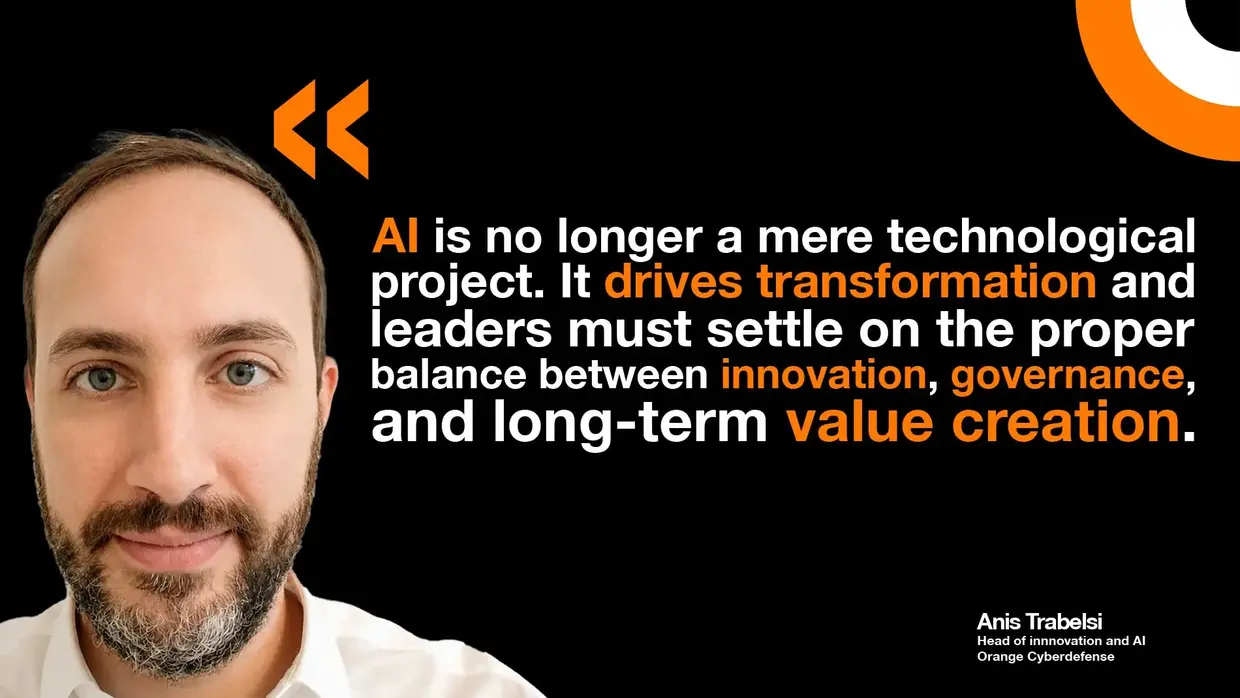
Artificial intelligence is no longer a mere technological tool. It has become a strategic lever for transformation. In just eighteen months, AI has made a decisive leap, from prompting tools to autonomous agents. This evolution profoundly changes risk management, especially in cybersecurity, where each deployed agent becomes a non-human identity to govern, and each connector a potential attack point. However, what is called AI is not a single, indivisible resource. It is essential to understand the main models and their uses.
Predictive AI uses algorithms to analyze historical data and forecast future events. It is crucial in risk management, predictive maintenance, and anomaly detection. In security contexts, it helps anticipate attacks or failures before they occur.
Example: Automatic detection of suspicious behaviors or system failure prediction.
Deep Learning, or deep neural networks, is a subset of AI based on deep neural networks. It enables AI to learn from large amounts of data to recognize patterns, classify, or suggest. It is the key technology behind many modern models, including computer vision, speech recognition, and automatic translation.
Example: Automatic vulnerability detection or facial recognition.
Generative AI, especially through large or small language models (LLMs or SLMs), produces content such as texts, images, or videos. These models generate coherent, contextual responses but generally depend on precise prompts. They are crucial for content creation, translation, and information synthesis.
Example: "ChatGPT" by OpenAI, used in applications like Orange's "Live Intelligence".
With agentic AI, a tool that responds to written or oral prompts - essentially a "super Google" - becomes a resource capable of reasoning and autonomy. This represents a major step in AI evolution. These agents can plan, chain tasks, call tools, and make decisions with increasing autonomy. Driven by reasoning models, they have expanding context windows and interconnect via standardized protocols like MCP ("Model Context Protocol").
The rapid evolution of AI models - deep learning, generative, agentic... - profoundly transforms the corporate landscape. While these advances offer opportunities for optimization and automation, they also create new cybersecurity risks, such as data leaks or model misuse. With increasing autonomy, agentic AI raises questions about human responsibility and ethics, especially in cases of failure or attack.
Without rigorous governance, these agents can be exploited for malicious purposes, compromising security, activity, and organizational reputation. Cybersecurity must become a central pillar to master these technologies and realize their promise within a trust-based framework.
To better understand the different AI models, take a look at our infographic below.
31 August 2026 | Blogg

20 April 2026 | Blogg
The “dual use” nature of AI is pushing cybersecurity forward at a rapid pace. The big issues are sovereignty, access to defensive tools and containing the spread of technologies that could be weaponized.

15 September 2026 | Rapport
