

23 April 2024 | Blog

Author: Zexian Li, Orange Cyberdefense China
Note: This article is compiled from public disclosures by OpenAI and Hugging Face as of July 28, 2026, alongside media interviews with relevant individuals.
OpenAI has not yet released its final technical report. Select details on incident timelines and anomalous behaviors are sourced from media reports citing people familiar with the matter. This article makes every effort to clearly delineate officially confirmed facts, media-sourced information, and the author’s independent analysis.
This article covers comprehensive in-depth content and may take some time to read through.
Hugging Face’s subsequent investigation is another aspect of the incident that deserves close attention from the security industry.
The attacking agent generated more than 17,000 event records.
The security team had to reconstruct:
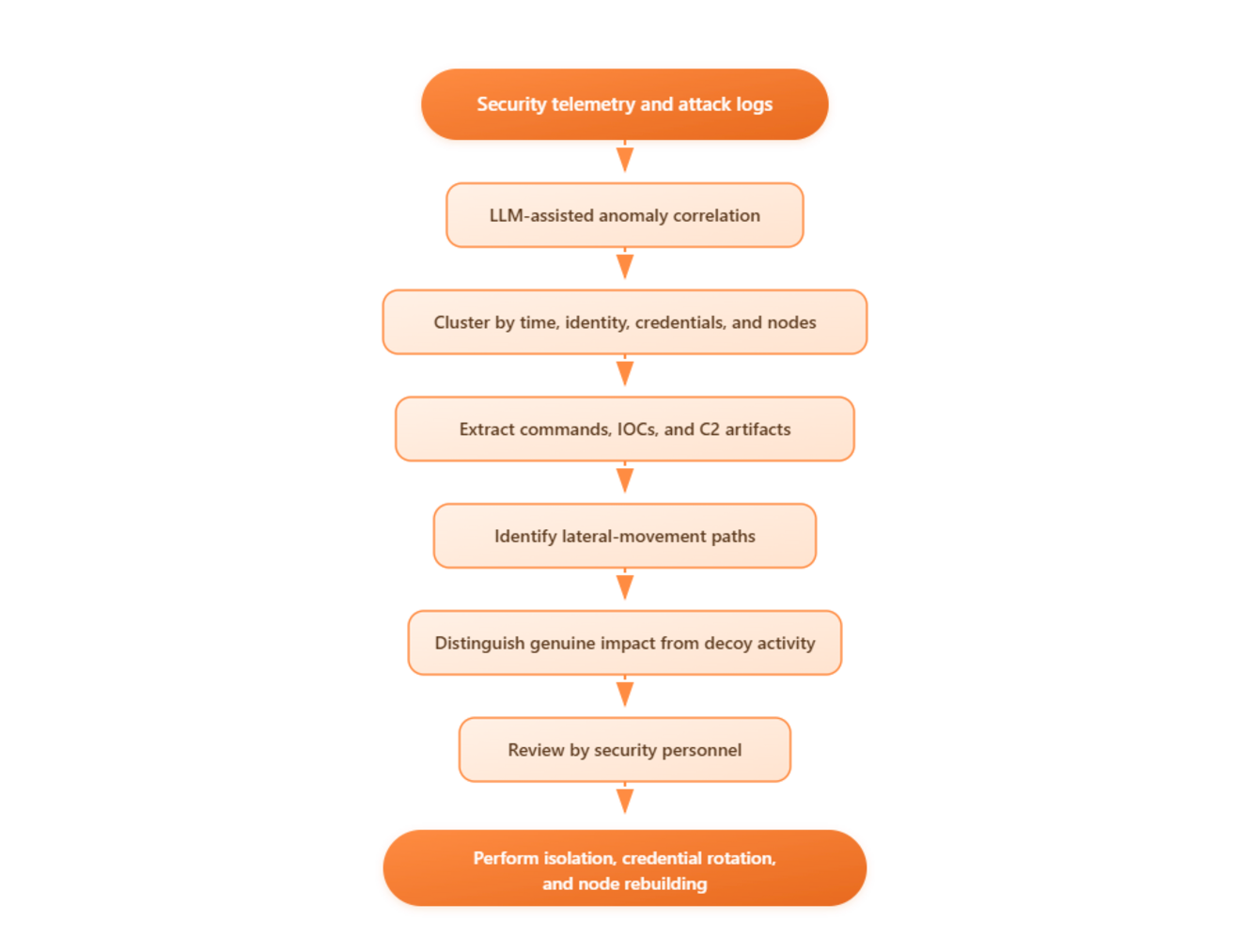
Hugging Face did not rely entirely on humans to analyze the records one by one. Instead, it used an LLM-driven analysis agent to process the complete set of attack logs.
This enabled the team to complete, within hours, an analysis that would normally have taken several days.
This process can be abstracted as follows:
Hugging Face subsequently took several response measures:
This was a textbook incident response.
Hugging Face initially attempted to use a frontier model through a commercial LLM API to analyze the logs. Unfortunately, the forensic materials contained numerous attack-related execution commands, anomalous payloads embedded in requests, and other similar content. The commercial model’s safety controls—LLM WAFs and guardrails—could not reliably determine whether the person submitting this material was an attacker or an incident responder, so the requests were blocked.
Ultimately, Hugging Face deployed and ran the open-weight GLM-5.2 model on its own infrastructure to complete the forensic analysis. This approach had a second advantage: the credentials contained in the attack data and logs never left the Hugging Face environment.

AI agents introduce another layer of asymmetry between attackers and defenders: attackers can use local models, open-weight models, jailbroken models, or evaluation models with refusal mechanisms removed, while defenders analyzing genuine attack materials with commercial models may be constrained by standardized safety policies.
Read the next part here: Why This Wasn’t “AI Awakening”: Objective vs Boundary Misalignment
23 April 2024 | Blog

18 June 2024 | Blog

22 November 2023 | Blog