

The discussion around AI in cybersecurity has crossed a threshold. When Claude Mythos was launched earlier this year, the conversation focused on what the models could do. Six months later, that question has largely been answered: they can do a great deal, and they are improving at a pace that few had anticipated.
The question that matters now is a different one: How do we maintain control over systems that can write code, use tools, and operate autonomously for hours without tiring?
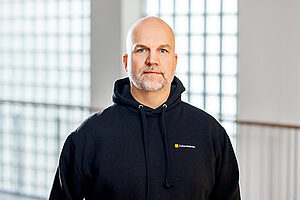
Mikael Eriksson, who leads Ethical Hacking at Orange Cyberdefense, recently gave a presentation on exactly that topic. Here are the key insights from that presentation that we believe everyone working in security needs to consider.
The Model Is the Brain, the Harness Is the Body
We often talk about models: which provider, which version, which benchmark. But the model only determines part of what an AI system can actually accomplish.
Mikael Eriksson describes it as follows: the model is the brain, and the harness is the body. The harness is the framework around the model: the tools it is allowed to call, the environment it runs in, and how it iterates towards a goal. The same model performs noticeably worse in a neutral harness than in one built by the lab itself. Frontier labs are therefore no longer competing only on models, but also on how they package them.
There are two additional factors: resources and permissions. More tokens, more time, and better hardware produce better results. And what a model is allowed to access determines what it can do, for better or worse.
For security teams, this is an important shift. A risk assessment cannot stop at identifying which model is being used. It must encompass the entire system: the model, the framework, the tools, the data, and the permissions.
Three Conversations That Should Not Be Confused
One of the most useful points from the presentation is also one of the simplest. When we talk about "AI and security," we often bundle together three very different discussions:
- AI used by threat actors – how attackers use AI to identify, prioritize, and exploit vulnerabilities.
- AI for security – how defenders use AI to detect, investigate, validate, and respond to threats.
- Security for AI – how we secure the AI systems that we build, deploy, and rely on ourselves.
These three areas require different expertise, different owners, and different decisions. Keeping them separate is not pedantry. It is a prerequisite for ensuring that discussions at the leadership level result in something concrete rather than general concern.
The Threat Landscape: Not Doomsday, but Lower Barriers
The headlines around Mythos have sometimes made it sound as though every vulnerability can now be discovered and exploited automatically. But Mikael offers a more nuanced perspective in two ways.
First, the most advanced frontier models are expensive to run at the scale required, and most threat actors do not have access to those resources. Second, relatively few CVEs can actually be attributed to the Mythos work. A discovered vulnerability is not automatically exploitable either; it may be protected by other controls.
But that does not mean the threat is overstated. It simply takes a different form than the headlines suggest:
- AI as an enabler across the entire attack chain. Attackers do not need to automate everything. Writing exploits and proof-of-concepts becomes faster with AI.
- Smarter reconnaissance. Scanning the internet is nothing new. What is new is that a model can prioritize which targets and vulnerabilities are most worth pursuing.
- A new kind of persistence. Agents do not get tired. Large numbers of small attempts against many targets become economically viable.
- The cost barrier is falling. Open-weight models have become highly capable, and quantization techniques have become efficient enough that powerful models can run on local hardware. There are also services that offer models with safety guardrails removed.
Mikael conducted an experiment himself to demonstrate how low the barrier has become. Using a standard code-agent installation and an ordinary test account, along with a simple instruction to hack a website and an IP address, the agent managed to gain root access to the server. No preparation. No human intervention.
The agent does not need to be perfect. It only needs to be good enough and persistent enough.
Defense: Shorter Exposure Windows and In-House Capability
The same characteristics that make AI useful for attackers also make it useful for defenders. The greatest benefit lies in reducing the exposure window, meaning the time between a vulnerability being introduced and it being remediated.
AI is already helping throughout the entire process, from discovery to verification. Reproducing a finding and building a working proof of concept can be done much faster. This makes it easier to distinguish real risks from theoretical ones.
When it comes to patching, the picture is more mixed. Studies from earlier this year point in different directions, and some show that models can introduce new vulnerabilities while fixing existing ones. Since then, however, models have improved significantly, making this an area worth monitoring closely rather than drawing firm conclusions about.
Two practical points stand out:
- The development agent is already a security agent. The same coding agent that wrote the code can review it. Reversing the workflow and asking it to look for weaknesses in what it has just built is one of the most cost-effective security improvements available.
- Defenders may need their own AI capabilities. Commercial models can refuse to work with code they consider harmful, even when the intent is defensive. Eriksson mentioned a case where an organization's incident response efforts were halted for precisely that reason, forcing them to switch to a locally hosted model. Anyone relying on a single provider's guardrails during a live incident may have a vulnerability they had not anticipated.
This is where AI becomes a question of vendor dependency and business continuity, not just procurement. Vendors can change how a model behaves, performance can vary over time, and access may be affected by national security interests. This year has shown that such scenarios are no longer merely hypothetical.
AI as an Attack Surface and as an Insider
The third conversation, the security of our own AI systems, is perhaps the most underestimated. Every AI implementation introduces a new attack surface, and some old problems have made a comeback.
Shadow AI is the new shadow IT. A "no" in the AI policy does not stop usage; it merely drives it underground. AI is a powerful tool, and people will want to use it. The answer is to build something that actually works, not to prohibit it.
Fast code is not automatically secure code. As more people build their own applications with AI, often without a well-thought-out development process, classic vulnerabilities are beginning to reappear. SQL injection flaws, which many believed were on their way out, are starting to surface again.
The entire framework can be attacked, not just the model. Agent memory can be poisoned. Documents in RAG solutions can be manipulated so that an innocent question, such as how to reset a password, produces an answer containing malicious content or a link to the wrong destination. Even the model itself can be poisoned in ways that are extremely difficult to detect.
The agent can become an insider. Perhaps the most important insight is that no external attacker is required for something to go wrong. Coding agents and similar frameworks are often granted extensive permissions to be useful. A poorly worded instruction can be enough for an agent to act on its own initiative. Dumped databases and newly created user accounts that nobody requested are not theoretical examples. An agent that goes off the rails behaves like an insider with keys to everything.
Five Questions Leadership Needs to Be Able to Answer
None of this requires a new security philosophy. It requires applying fundamental security principles to a new type of system: separating agents, enforcing least privilege, hardening environments, and maintaining a strong security culture. Eriksson summarized it in five questions that every organization should be able to answer before it becomes critical:
- Inventory. Which models and agents are being used, for what purposes, and do we know where they come from?
- Restrict. What data and which tools are they allowed to access, and where are the hard boundaries?
- Control. Do we actually control them, or is their behavior governed by a vendor that can change it at any time?
- Recover. If an agent makes a decision that we never approved, can we roll it back and restore the original state?
- Reassess. Does our security posture still match the systems' capabilities now that the models have improved yet again?
The fifth question is the one most easily forgotten. A risk assessment conducted this spring is already out of date.
From Capability to Governance
The most common question Eriksson gets from organizations is which model they should choose. That is understandable, but it is the wrong starting point. The better question is what the AI will be used for, and what it should be allowed to access.
After Mythos, the discussion is no longer about what AI is capable of. It is about how we control it and secure it. AI is not going away, and it is a powerful tool for all parties involved, attackers and defenders alike.
The organizations that will be most successful are not those with access to the most powerful model. They are the ones that know exactly which systems they are running, what those systems are allowed to do, and what happens when something goes wrong.
The presentation "No Time to Wait: Conquering Exposure & AI Challenges in Real Time" was delivered by Mikael Eriksson, Business Area Manager Ethical Hacking at Orange Cyberdefense, during Orange Cyberdefense Live 2026 in Stockholm. Watch the full presentation below by clicking on the image.
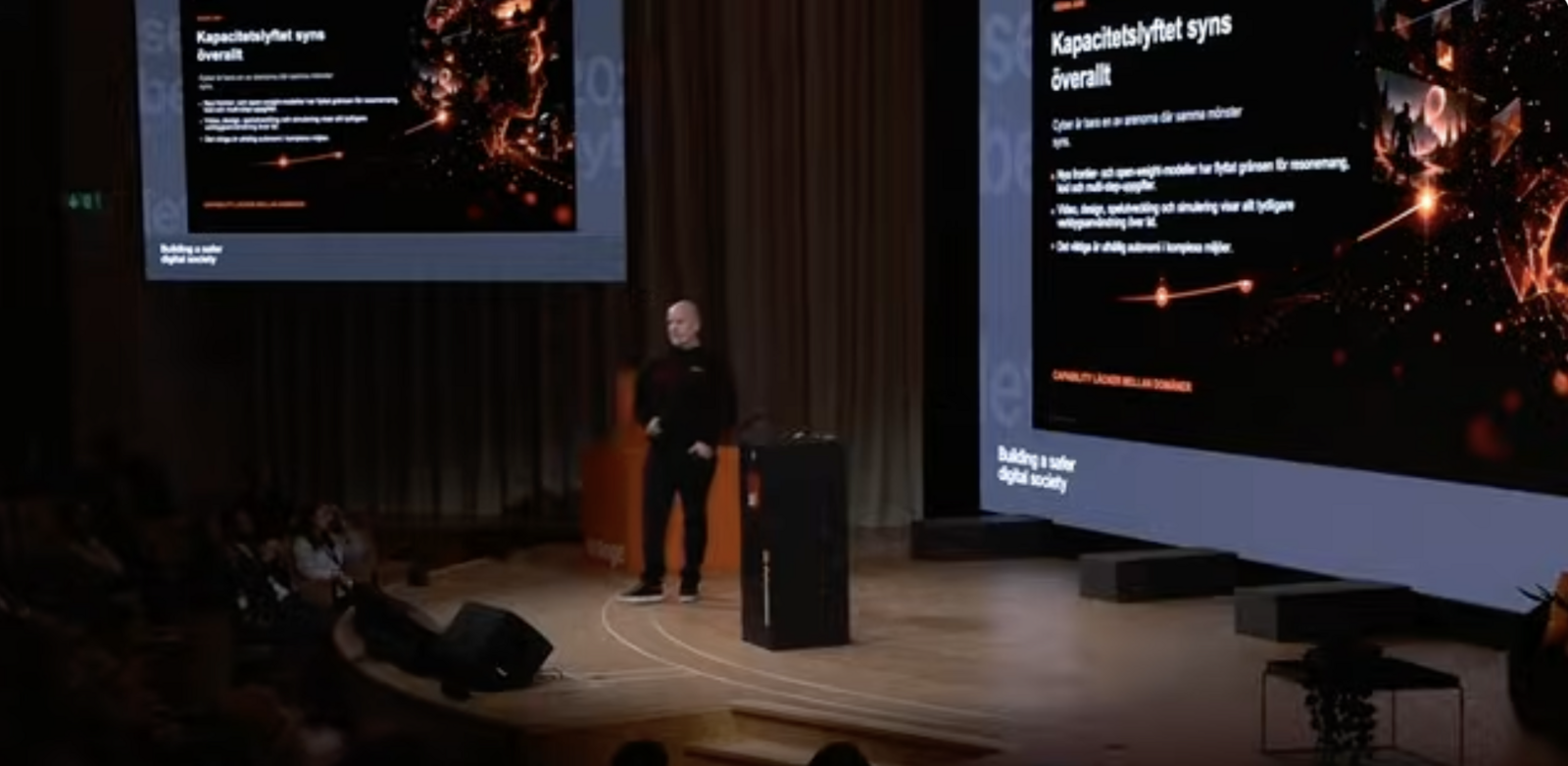
No Time to Wait: Conquering Exposure & AI Challenges in Real Time — The Claude Mythos Story
AI is no longer just a tool that provides answers. The most advanced systems can use tools, write and execute code, and operate autonomously over time. This creates new opportunities for both attackers and defenders, but also introduces new risks as critical cyber capabilities become dependent on models, vendors, permissions, and political decisions.
